

Python
About Python
Learning Python
is as easy as
A B C
In the early 1990s, Python is widely used in the processing of system management tasks and Web programming. The founder of Python is the Dutch Guido Van Rossum. The reason that Python was being invented is that at first, it started as a hobby project, but during the Christmas of 1989, Guido decided to develop a new script interpreter as an inheritance of the ABC language in order to pass the dull Christmas. The reason for choosing Python as the name of the programming language came from the television comedy "Monty Python's Flying Circus". Hence, during his invention, he decided to name it as Python!
The first version of Python was Python 0.9.0, released in 1991. Furthermore, other than exception handlings capabilities, such as classes, lists, and strings also included in Python. Above all, it also provide lambda, map, filter, and reduce, which have a lot to do with functional programming.
The second version of Python was Python 2.0, released on 2000. This version is created by members of the National Institute of Mathematics and Computer Science and it was more like an open-source project. Aside from that, this version of Python being introduced various main new features, such as list comprehensions, a cycle-detecting garbage collector and it also supported Unicode.
On 2008, Python 3.0 was the next version that is released. Python 3.0 is a critical revision of the language as it is not fully backward compatible. Many of its main features have backported to the Python 2.6.x and 2.7.x release series. The Python 3 release includes two or three utilities that automatically (at least partially) can convert Python 2 code to Python 3.
Python is a multi-paradigm programming language. Object-oriented programming and structured programming are fully supported, and many of its features support functional programming and aspect-oriented programming. Many other paradigms are supported via extensions, including design by contract and logic programming.
Python's design offers some support for functional programming in the Lisp tradition. It has filter, map, and reduce functions; list comprehensions, dictionaries, sets and generator expressions. The standard library has two modules (itertools and functools) that implement functional tools borrowed from Haskell and Standard ML.


(Computer Software)


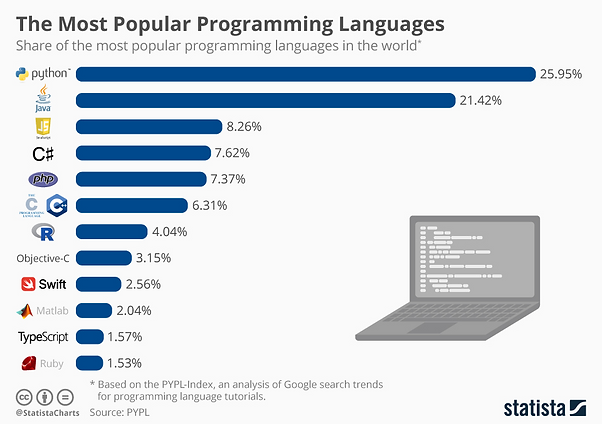
Python is currently the most popular programming language among others.
Python is so popular because it is easy to learn. It was designed as a general purpose language so it has human-readable syntax which is human-friendly compare to other programming languages.
Python is more efficient than others. Python can get more work to be done with lesser lines of code than C++, and it can be used across a variety of environments such as web development, mobile development and hardware programming.
Then, the escalating of AI, machine learning, and data science also caused Python to be popular because Python powers countless data processing workloads. For example, YouTube is using Python for several purposes such as processing a huge load of canonical data from the users.
Python program runs directly from the source code, this is the interpretation part. However, the .py source code is compiled to byte code as .pyc and then being interpreted.
In short: Python, interpreted or compiled? The answer is YES. Because it is a bit of both.
There are lots of IDE available for Python. There are Eclipse+,PyDev, Visual Studio, Atom etc. New Python developers should try those with as few customizations as possible as it will confuse the users.